
How Math Practice and a Math Workbook Can Sharpen Your Skills
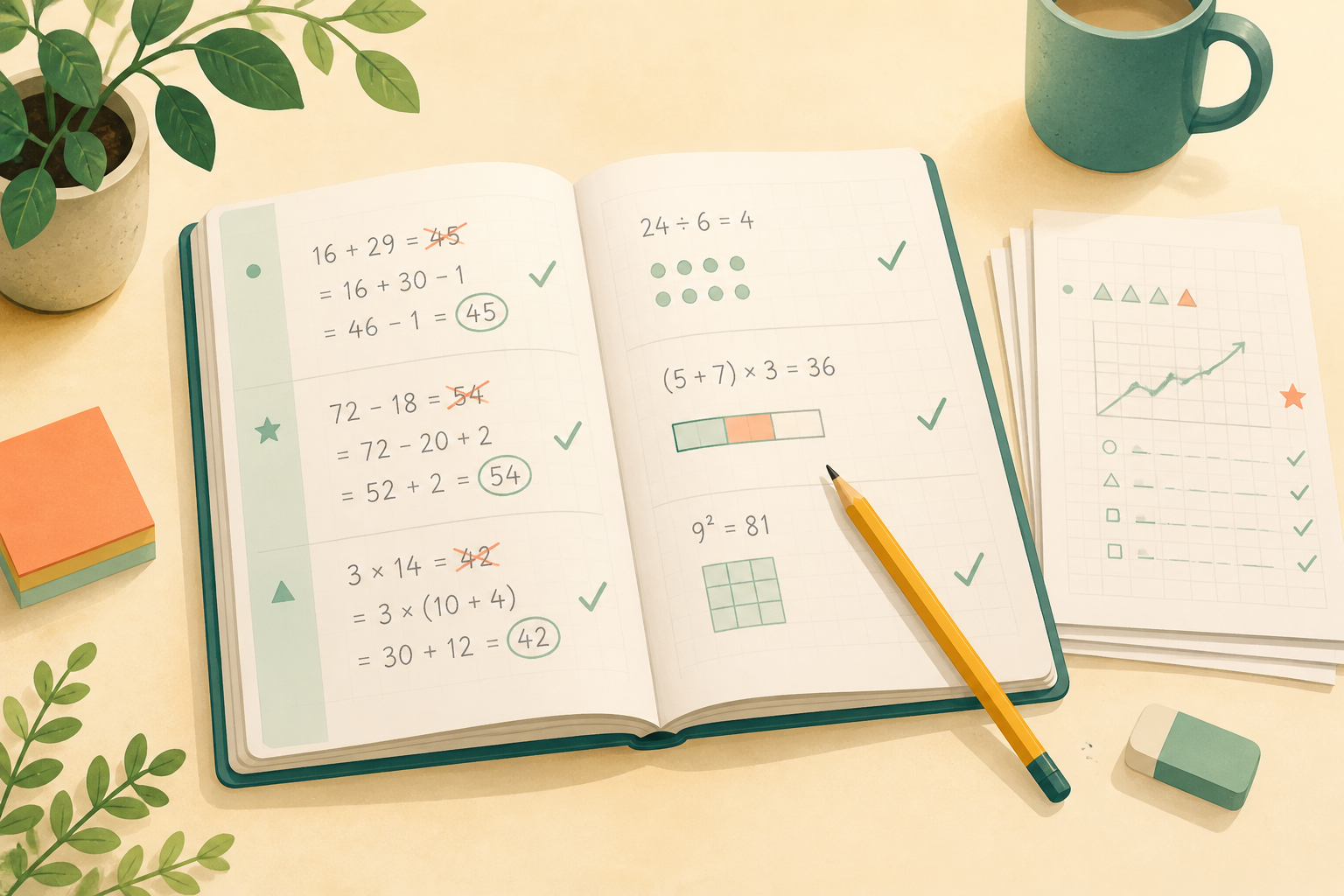
Some students seem naturally good at math. They understand a new lesson quickly, recognize patterns almost immediately, and finish problems before everyone else. From the outside, this ability may look like pure talent.
Other students need more time. They study the example twice, make mistakes, erase their work, and try again. Their progress may not look impressive at first, but something important is happening: they are developing the habits, knowledge, and problem-solving strength that lead to long-term success.
This is where the idea behind “Hard Work Beat Talent” becomes meaningful.
The real story is not that talent has no value. Talent and hard work are two sides of the same story. Talent may influence where someone begins, but consistent and intelligent effort has a major influence on how far that person progresses. In mathematics, a well-designed math workbook combined with regular math practice can transform uncertainty into understanding and weak skills into lasting confidence.
This message is especially important today. According to the latest National Assessment of Educational Progress long-term trend results, the average mathematics score for 9-year-old students increased by four points between 2022 and 2025. However, it remained four points below the 2020 pre-pandemic score. For 13-year-olds, the 2025 mathematics score showed no significant improvement from 2023 and remained below the 2020 level. These results suggest that math recovery is happening unevenly and that many students still need consistent opportunities to strengthen their foundational skills.
Talent May Open the Door, but It Does Not Finish the Work
Talent can give a student an early advantage. Some learners may process information faster, remember number facts more easily, or recognize mathematical relationships with less explanation. Previous knowledge, attention, confidence, learning opportunities, and natural differences in cognitive ability can all affect how quickly a student understands a new concept.
However, early speed should not be confused with future mastery.
A talented student who avoids challenging problems may stop growing. A student who has always received high scores without much effort may become discouraged when advanced algebra, geometry, or calculus finally requires sustained concentration. Because that student has not practiced responding to difficulty, the first serious struggle can feel like evidence that the talent has disappeared.
Meanwhile, a student who has learned how to work through confusion may be better prepared. That student knows how to review an example, break a problem into steps, identify an error, ask a useful question, and try a different method.
Research on expertise supports a balanced conclusion. Practice is an important contributor to high performance, but it does not explain every difference between individuals. Studies have found relationships between achievement and both practice and cognitive abilities. In other words, natural differences matter, but they do not replace training, instruction, feedback, and experience.
That is why the most accurate message is not “talent does not matter.”
The better message is this:
Talent may affect the starting point. Hard work, effective instruction, and consistent practice shape the journey.
Hard Work Must Be More Than Repetition
Hard work is powerful, but only when it is directed toward improvement.
Completing fifty identical problems without thinking is not necessarily effective math practice. A student can repeat the same mistake fifty times. Spending hours looking at solved examples is also not enough if the student never attempts to solve a problem independently.
Productive hard work has several characteristics:
- It focuses on a specific skill.
- It includes problems at an appropriate level of challenge.
- It gives the learner clear feedback.
- It requires the learner to correct mistakes.
- It returns to important material over time.
This approach is often described as purposeful or deliberate practice. Instead of simply “doing more,” the learner identifies a weakness and works directly on it.
For example, a student may understand how to solve one-step equations but make mistakes with negative numbers. Completing more random equations may help a little, but targeted practice with integer operations will address the actual weakness. Once that weakness improves, the student can return to equations with greater accuracy.
Hard work becomes effective when effort has a clear destination.
The Science Behind Effective Math Practice
The U.S. Department of Education’s Institute of Education Sciences recommends several learning strategies that apply directly to mathematics. These include spacing learning across time, alternating worked examples with independent problem solving, using quizzes to revisit important content, and asking students to explain their reasoning deeply.
These recommendations explain why short, regular study sessions are usually more useful than one exhausting session before a test.
Spaced Practice
Spaced practice means reviewing a skill over several days or weeks instead of completing all practice at once.
A student may work on fractions on Monday, review them briefly on Thursday, and encounter them again in mixed practice the following week. Each return requires the student to recall information that has started to fade. That effort strengthens long-term retention.
A good math workbook can make spacing easier by including cumulative reviews, chapter checks, mixed exercises, and full-length practice tests.
Retrieval Practice
Reading an explanation can create a feeling of familiarity, but familiarity is not the same as mastery.
Retrieval occurs when students must bring a procedure, fact, or concept back from memory. Solving a multiplication problem without looking at a chart, writing an equation from a word problem, or explaining why two fractions are equivalent are all forms of retrieval.
This is one reason independent math practice matters. The blank space beneath a problem asks the student to produce the reasoning rather than simply recognize it.
Research supported by the Institute of Education Sciences has found that actively recalling information can improve learning and help students retain information longer than some forms of passive review.
Interleaved Practice
Many traditional assignments group similar problems together. A student may complete twenty problems using exactly the same procedure. This can build initial fluency, but it may also make the task too predictable.
Interleaved practice mixes different problem types. The student must decide which strategy to use before calculating the answer.
In one randomized study highlighted by the Institute of Education Sciences, students who received more interleaved mathematics practice scored 61 percent on an unannounced test, compared with 38 percent for students who received blocked practice. The result does not mean every workbook must mix every problem from the beginning. It shows that selecting the correct method is an important part of mathematical learning.
Worked Examples and Independent Problems
Worked examples allow students to study how a problem is solved. Independent problems require them to apply that knowledge.
Both are necessary.
A high-quality math workbook should not provide pages of unexplained questions, nor should it provide so much guidance that the student never thinks independently. Effective learning moves gradually from explanation to guided practice and then to independent work.
The student first sees the path, then walks the path with support, and finally completes it alone.
How a Math Workbook Sharpens Math Skills
A workbook is more than a collection of questions. When it is organized carefully, it becomes a system for building knowledge.
1. It Creates a Clear Learning Sequence
Online videos and digital resources can be helpful, but students may move randomly between topics. They might watch a lesson on percentages, switch to geometry, and then attempt algebra without mastering the necessary foundations.
A structured math workbook creates order. Lessons can move from basic concepts to more complex applications so that each skill supports the next one.
This reduces unnecessary confusion and helps learners see how mathematical ideas connect.
2. It Makes Practice Active
Watching someone solve a problem can make the process look easy. The real test begins when the student has to solve a new problem independently.
Writing each step, organizing calculations, drawing a model, and checking an answer create active involvement. A workbook gives students a dedicated place to perform this work instead of only observing it.
In an age when calculators, apps, and artificial intelligence can produce answers within seconds, the ability to evaluate an answer is becoming even more important. Technology may provide a result, but the learner still needs enough mathematical understanding to recognize whether that result is reasonable.
3. It Turns Mistakes Into Information
Mistakes are not proof that a student lacks talent. They show where learning needs to continue.
A wrong answer may reveal a forgotten rule, a calculation error, a misunderstanding of vocabulary, or a weak prerequisite skill. When students review their errors carefully, they learn what to improve next.
A useful habit is to keep an error log with three simple questions:
1. What mistake did I make? 2. Why did I make it? 3. What will I do differently next time?
This process turns frustration into a plan.
4. It Builds Fluency Without Sacrificing Understanding
Math fluency means completing familiar processes accurately and efficiently. It does not mean memorizing steps without understanding them.
When basic skills become more automatic, students can devote more attention to reasoning, modeling, and complex problem solving. A student who does not have to struggle with every multiplication fact has more mental energy available for fractions, ratios, equations, and geometry.
Regular math practice helps students build this fluency, while explanations and application problems protect against shallow memorization.
5. It Makes Growth Visible
Students often compare themselves with classmates who appear more talented. A workbook offers a healthier comparison: today’s performance compared with yesterday’s performance.
An early page may contain corrections and unfinished problems. Several weeks later, the same student may solve similar questions with greater speed and confidence. That visible progress supports a growth mindset, because improvement is no longer an abstract promise. It can be seen on the page.
Growth Mindset Does Not Mean Effort Alone
A growth mindset is sometimes misunderstood as simply telling students to “try harder.”
Trying harder is not always the answer. A student may also need a clearer explanation, a different example, additional background knowledge, more time, or feedback from a teacher or parent.
A real growth mindset combines effort with strategy.
When one method does not work, the learner does not repeat it forever. The learner adjusts the approach. That may mean returning to an easier problem, using a visual model, studying a worked example, asking for help, or practicing a missing prerequisite.
The message is not, “You can accomplish anything instantly if you believe in yourself.”
The message is, “Your current performance is not your permanent limit, and there are actions you can take to improve.”
A Simple Math Practice Routine That Works
Students do not always need hours of daily study. A focused routine of approximately 20 to 30 minutes can be valuable when it is completed consistently.
A practical session can include:
Five minutes of review: Complete several questions from previously learned topics.
Ten minutes of focused learning: Study one concept or one worked example.
Ten minutes of independent practice: Solve problems without copying the example.
Five minutes of correction: Check answers, identify errors, and write one lesson learned.
The next session should include one or two problems from the previous lesson. At the end of the week, the student can complete mixed practice that requires choosing among several strategies.
This routine uses spacing, retrieval, feedback, and interleaving without making study feel overwhelming.
Hard Work and Talent Are Two Sides of the Story
Talent should be respected, but it should never become a label that limits a student.
Calling one child “a math person” and another child “not a math person” can turn a temporary difference into a permanent identity. Mathematics is not a gift reserved for a small group of naturally gifted people. It is a field of knowledge developed through explanation, reasoning, experience, correction, and repeated use.
At the same time, hard work should not be romanticized. Students deserve quality instruction, useful feedback, appropriate materials, and enough support to make their effort productive. A poorly designed assignment can create exhaustion without meaningful learning.
The strongest results come when effort and opportunity work together.
Talent may help a student learn the first lesson quickly. Hard work helps that student continue when lessons become difficult. A math workbook provides structure. Consistent math practice creates experience. Feedback corrects the path. A growth mindset helps the learner continue after mistakes.
Together, these elements sharpen mathematical skills and build something more valuable than a temporary test score: the ability to approach difficult problems without giving up.
The Final Lesson
A student does not become strong in mathematics by waiting to feel talented.
Strength develops one problem at a time.
Every corrected mistake improves awareness. Every reviewed lesson strengthens memory. Every challenging problem develops patience. Every completed page provides evidence that ability can grow.
Talent may give someone an early lead, but an early lead does not determine the final result. The student who practices thoughtfully, learns from errors, and continues working can eventually move beyond the student who relies only on natural ability.
That is why hard work can beat talent—not because talent is unimportant, but because talent without continued development has limits.
Open the math workbook. Begin the next problem. Check the answer. Learn from the mistake. Return tomorrow.
That is how skills become sharper, confidence becomes stronger, and progress becomes real.
Government and Scientific References
1. U.S. Department of Education, National Center for Education Statistics. *NAEP 2025 Long-Term Trend Assessment Results: Reading and Mathematics.*
2. U.S. Department of Education, Institute of Education Sciences and What Works Clearinghouse. *Organizing Instruction and Study to Improve Student Learning.*
3. Institute of Education Sciences. *An Efficacy Study of Interleaved Mathematics Practice.*
4. Scientific research examining the combined roles of practice, intelligence, and other individual differences in expert performance.
Hi, this is a comment.
To get started with moderating, editing, and deleting comments, please visit the Comments screen in the dashboard.
Commenter avatars come from Gravatar.