📖 Reading time: 14 min
Quick answer: STEM and STEAM teach the same four subjects — science, technology, engineering and math — but STEAM adds the arts and design as a fifth strand, and only STEM has an official federal definition tied to real occupations and wage data.
Who this is for: parents choosing between a STEM and a STEAM program, teachers deciding how to label a club or elective, and homeschool families picking books for a middle schooler.
One letter separates the two words, and almost nobody can tell you what it actually changes. Schools advertise STEAM labs. Camps sell STEM weeks. Parents sign up for both and quietly wonder whether they just bought the same thing twice.
Here’s a number that cuts through the branding. The U.S. Bureau of Labor Statistics projects STEM employment to grow 8.1 percent between 2024 and 2034, against 2.7 percent for non-STEM occupations, and it put the 2024 median wage for STEM occupations at $103,580 — more than twice the $48,000 median for non-STEM work. That gap is measured against a specific, published list of occupations. There is no equivalent list for STEAM, because STEAM is a teaching philosophy rather than a labor category.
That doesn’t make STEAM worse. It makes the two words answer different questions, and this guide separates them properly: what each term covers, what the evidence says about outcomes, and six questions that will tell you in about ten minutes which one fits the child in front of you. You’ll also see the same project built three ways, so you can watch the difference instead of reading about it.
STEM vs STEAM: The Real Difference
What each letter stands for — and which one is official
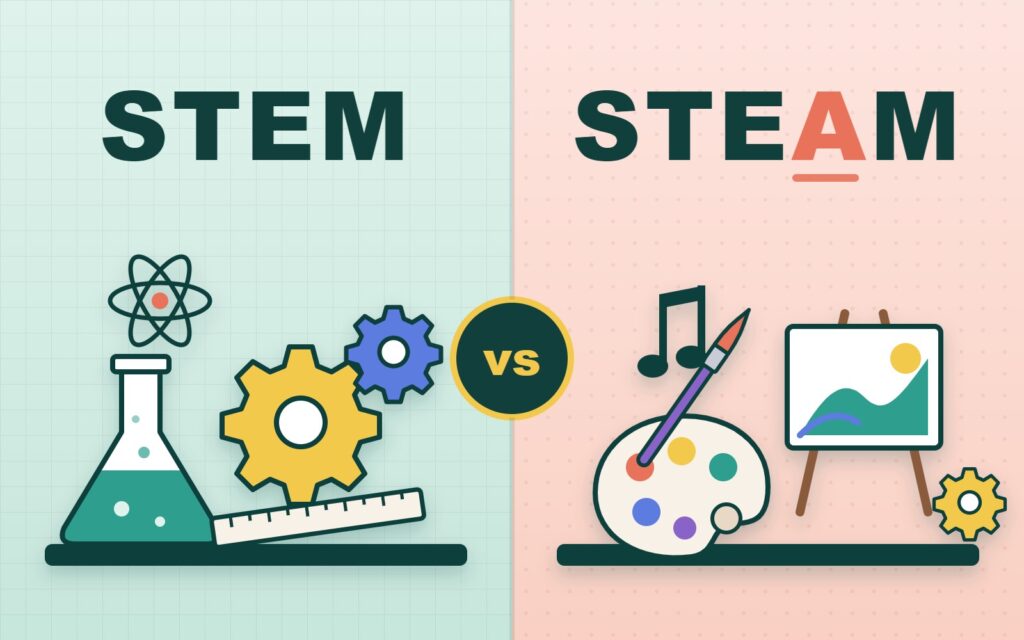
STEM stands for science, technology, engineering and mathematics. STEAM is the same four plus an A for the arts, usually meaning visual art, design, and sometimes music, writing and the humanities. That’s the whole surface-level difference, and it’s where most explanations stop.
The deeper difference is that the two terms live in different worlds. STEM is a workforce classification before it is a school subject — federal agencies maintain lists of which occupations count as STEM, and those lists drive wage reporting, visa categories and funding. STEAM has no equivalent official definition. It grew out of arts-education advocacy as an argument that design thinking belongs inside technical work, and it stayed a philosophy.
This matters practically. When a school says “our STEM program,” you can usually map it to recognizable subjects and courses. When a school says “our STEAM program,” you have to ask what they actually do, because the label is not standardized and two STEAM classrooms can look nothing alike.
Here’s what genuinely separates them in day-to-day teaching:
- What counts as a right answer. In a STEM task, the bridge holds the load or it doesn’t, and the data either supports the claim or it doesn’t. A STEAM task usually adds a dimension that’s judged rather than measured — is it beautiful, is it persuasive, does it communicate. Both are real skills, but only one of them can be graded against a standard.
- Where the constraint comes from. STEM projects are constrained by physics, budget and the specification. STEAM projects add constraints drawn from audience and aesthetics. Students who thrive on clear rules often prefer the first; students who stall without room to make something their own often need the second.
- What gets assessed. STEM work produces measurable artifacts — a working circuit, a defensible dataset, a model that predicts. STEAM work frequently produces a presentation, exhibit or portfolio. Ask any program which of these your child will actually be assessed on, because that tells you what they’ll practice most.
- How the subjects connect. Good STEM teaching integrates four fields around one problem. Good STEAM teaching does the same with five. Weak versions of either simply run the subjects side by side and call the timetable integration — that’s the failure mode to watch for in both.
If you want to see how the federal government draws the STEM boundary in practice, the Bureau of Labor Statistics publishes the occupational grouping it uses and the projections built on it in its report on projected STEM employment growth.
Why the argument got heated
The push to add the A was partly a defense of arts budgets at a time when STEM funding was expanding and arts programs were being cut. That origin is worth knowing, because it explains why the debate can feel political rather than practical.
For a family choosing a book or a club, the politics don’t matter much. What matters is whether your child spends the hour building, testing and revising something — which both good STEM and good STEAM do — or sitting through a lecture with a craft activity bolted on, which neither should be.
What the Numbers Actually Show
The payoff on one side, a warning on the other
The economic case for STEM is unusually clear, and it has widened rather than narrowed. STEM occupations are projected to grow 8.1 percent from 2024 to 2034 while all occupations together grow 3.1 percent and non-STEM work grows 2.7 percent. The 2024 median wage of $103,580 for STEM occupations against $48,000 for non-STEM is the headline most parents remember, and it’s a real measured gap, not a projection.
Now the warning, and it’s the reason this article exists. American middle schoolers are moving away from these subjects, not toward them. On the 2024 National Assessment of Educational Progress, released in September 2025, the average grade 8 science score fell 4 points against 2019, putting it level with where it stood in 2009. Only 31 percent of eighth graders reached NAEP Proficient, and 38 percent landed below NAEP Basic.
The decline was not evenly spread. Lower-performing students fell furthest, and students at the 10th and 25th percentiles recorded the lowest scores ever reported on the assessment. You can read the full breakdown in the National Assessment Governing Board’s release on the 2024 science results.
Put the two datasets side by side and the picture is uncomfortable. The occupations that pay double are growing three times as fast as everything else, and the grade that feeds them is losing ground. Whether you label the fix STEM or STEAM matters far less than whether the fix involves your child actually doing the work.
That’s where structured, hands-on material earns its place over a shelf of one-off activity ideas. Engineering Design STEM Activities for Beginners runs 50 two-page missions built on the engineering design process, each one a problem to define, a solution to build and a result to test — which is the loop both STEM and STEAM claim to teach and only sustained practice actually installs.
One honest caveat about the wage figure
The $103,580 median covers all STEM occupations, including ones requiring advanced degrees. It is not what a graduate earns on day one, and quoting it as a starting salary would be misleading. Read it as what the field pays across a career, and as evidence that the subjects keep their value — not as a promise attached to any one job.
The growth figure deserves the same care. An 8.1 percent increase over a decade is strong, but it describes the field, not your child’s odds in it. What improves those odds is competence, and competence comes from reps.
How to Choose: 6 Questions That Settle It
Choosing between STEM and STEAM comes down to what your child needs next, not which acronym sounds more complete. Work through these six and the answer usually arrives by the fourth.
- Does your child quit when there’s no clear right answer, or when there are too many rules? This is the single best predictor. A child who freezes at open-ended prompts needs the measurable targets STEM work provides, at least to build confidence first. A child who disengages the moment the method is dictated usually needs the creative latitude the A adds. Watch them on one task of each kind before deciding — their behavior will tell you faster than their opinion.
- What does the program actually do each session? Ask for a sample week, not a brochure. Count the minutes spent building, testing or analyzing versus listening. A STEM program where students watch demonstrations is worse than a STEAM program where they design and iterate, and the label on the door predicts this far less reliably than the schedule does.
- Is the arts component integrated or decorative? In strong STEAM, the design work changes the engineering — the shape of the prosthetic hand affects whether a person will wear it. In weak STEAM, students finish the science and then decorate a poster. If the art could be removed without changing the result, you’re paying for STEM with extra steps.
- What is your child aiming at in the next two years, not the next ten? Middle school choices should serve the next stage, not a guessed career. If high school course placement, a competition or a specific class is the near target, pick the one that builds the required skill. Ten-year career forecasts are a poor basis for an eleven-year-old’s Tuesday afternoons.
- Where is the gap right now? If science is the weak subject, strengthening it directly beats adding a fifth strand on top. The NAEP data says plainly that a large share of eighth graders are below the floor in science. A child in that group needs core ground recovered before breadth becomes useful.
- Can you simply do both? For most families the honest answer is yes, and the forced choice is an artifact of how programs are marketed. A STEM activity book at home alongside a school arts elective delivers both strands without paying twice for an integrated program. Treat the acronyms as a menu rather than a fork in the road.
One caution about a tempting shortcut. Parents often pick STEAM on the theory that it’s broader and therefore safer. Breadth has a cost: five strands in the same hour means less time on each, and a student who is already behind in science can fall further while producing lovely work. Broader is not automatically better for a child with a specific gap.
The reverse error is just as common. Choosing pure STEM for a child who has already decided they “aren’t a science person” often cements that belief. For them, the A is not a luxury — it’s the door back in, and the measurable work becomes possible once they’re through it.
The Same Project, Built Three Ways
Example 1: A load-bearing bridge
The task: Build a bridge spanning 30 cm from 20 drinking straws and one meter of tape.
As STEM: The success measure is mass supported before failure. Students predict which truss shape carries the most load, build two, test both to destruction and explain the result using what they know about triangles and force paths. The winning design is whichever number is higher.
As STEAM: The same build gains a client and a site — a footbridge in a public park. Students justify the form to a brief that includes how it looks and how people move across it, then still test it to failure.
What changes: The STEM version trains prediction and measurement. The STEAM version adds justifying a design to someone else’s requirements. Note that the load test survives in both — if a STEAM version drops the test, the engineering has quietly been removed.
Example 2: A week of local climate data
The task: Work with seven days of local temperature and rainfall readings.
As STEM: Students calculate mean, range and anomaly against a published average, identify which single day is the outlier, and state what the week does and does not support as a claim about the season.
As STEAM: Students build the same statistics, then design a visualization aimed at a specific audience — classmates, or a town council — and defend the choices of scale and color that make it readable or misleading.
What changes: The analysis is identical; the second version adds communication under constraint. This is the clearest case where the A earns its place, because a correct dataset presented badly persuades nobody. It’s also the clearest case where the A can become decoration if the statistics are skipped.
Example 3: A robot that sorts recycling
The task: Design a mechanism that separates metal cans from plastic bottles.
As STEM: Students test sensing methods — magnetism, weight, conductivity — then measure sorting accuracy across 50 items and report the error rate. The deliverable is a percentage.
As STEAM: The brief adds a user. The machine goes in a school cafeteria, so students design the labelling and interaction that make an eleven-year-old use it correctly in three seconds, then measure accuracy with real users rather than with items placed by hand.
What changes: The STEAM version is harder, not softer — it adds a variable that the engineering must survive. That’s the version of STEAM worth paying for. If a program’s STEAM work is consistently easier than its STEM work, the A is being used as a discount rather than an addition.
Frequently Asked Questions
Is STEAM better than STEM?
Neither is better in general — they suit different children and different gaps. STEAM adds arts and design as a fifth strand, which helps students who need creative latitude or who have decided science isn’t for them. STEM concentrates time on four subjects with measurable outcomes, which helps students rebuilding core ground. Judge the specific program by how much building and testing it involves, not by the acronym.
What does the A in STEAM stand for?
The arts — most often visual art and design, and sometimes music, writing and the broader humanities. There is no single official definition, so the A means different things at different schools. Ask any program directly whether the arts work changes the technical outcome or is added after it, because that distinction separates integrated STEAM from decorated STEM.
Does STEM or STEAM pay better later?
The wage data exists only for STEM, because STEM is an occupational classification and STEAM is a teaching approach. The Bureau of Labor Statistics put the 2024 median wage for STEM occupations at $103,580 against $48,000 for non-STEM. No comparable figure exists for STEAM, and any article quoting one is inventing it.
Which is better for middle school specifically?
For grades 6 to 8, the deciding factor is usually the current science gap rather than the acronym. With 38 percent of eighth graders scoring below NAEP Basic in science, many students need direct, hands-on practice in the core four before breadth pays off. If your child is already solid and losing interest, that’s when the arts strand tends to do the most good.
📚 More from Mathfa
🎯 Recommended STEM Book
Engineering Design STEM Activities for Beginners – 50 Hands-On Missions for Grades 6-8 — $18.99
Category: STEM Activities
Level D “Innovators” of the Mathfa STEM series: 50 two-page engineering design missions for ages 11-13, from The Engineering Design Process to Design Challenges & Communication. Instant printable PDF.
Key Takeaways
- STEM and STEAM teach the same four subjects; STEAM adds arts and design as a fifth strand. Only STEM has an official occupational definition and published wage data behind it.
- STEM occupations are projected to grow 8.1 percent from 2024 to 2034 against 2.7 percent for non-STEM, with a 2024 median wage of $103,580 versus $48,000.
- Meanwhile only 31 percent of eighth graders reached NAEP Proficient in science in 2024 and 38 percent fell below Basic — the gap the acronym argument distracts from.
- Judge any program by minutes spent building and testing, not by its label — Engineering Design STEM Activities for Beginners is 50 missions of exactly that loop.
The STEM vs STEAM question turns out to be the wrong one for most families. The right one is whether your child spends the hour making, measuring and revising something — and both labels can hide a classroom that does neither. Pick one project this week, run it the STEM way, and watch what your child does when the result can be measured. Ready to start with missions already built that way? Browse the Mathfa STEM activity books for grades 6–8.
