Physics Projects STEM Activities for Beginners – 50 Hands-On Missions for Grades 6–8
$18.99
Add to cart
$18.99
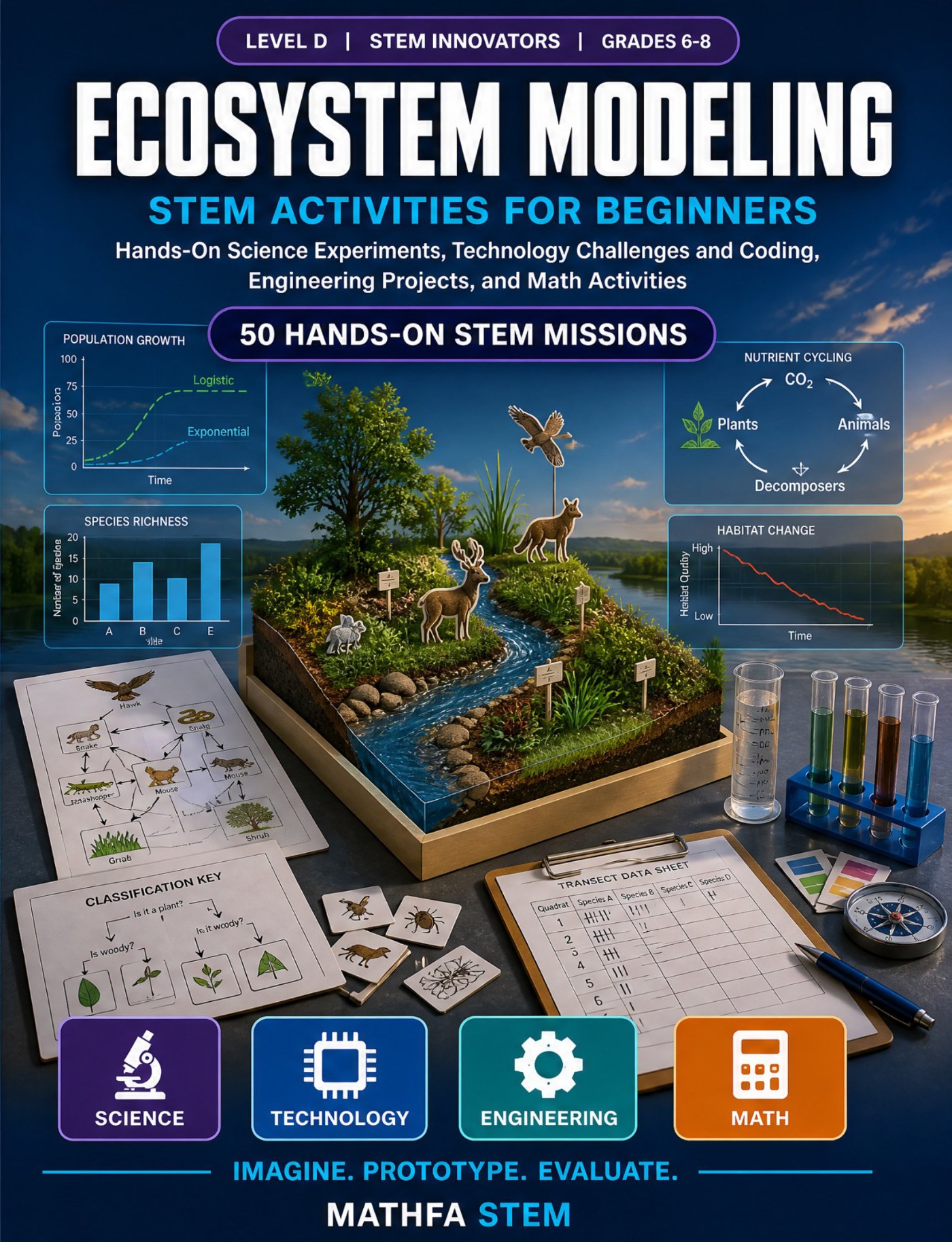
Sample, Model, Protect Like an Ecologist. 50 middle-school STEM missions in ecology — Look & STEM Idea and Try & Draw pages, For Grown-Ups notes and a certificate. Start exploring today.
Ecosystem Modeling STEM Activities for Beginners is a complete, hands-on ecology program for Grades 6–8. Fifty two-page missions across seven sections take students from core ideas to full investigations and design challenges, so they learn to work like a ecologist.
The book moves through seven sections: Food Chains & Energy Flow (8 missions, from What Is an Ecosystem? to Plan an Energy Investigation), Populations & Growth (7 missions, from What Is a Population? to Plan a Population Study), Community Interactions (7 missions, from Competition for Resources to Plan a Community Investigation), Biodiversity & Sampling (7 missions, from What Is Biodiversity? to Plan a Biodiversity Survey), Nutrient Cycles (7 missions, from Matter Cycles, Energy Flows to Model a Full Nutrient Cycle), Change & Human Impact (7 missions, from Ecological Succession to Weigh a Trade-Off) and Modeling & Design Challenges (7 missions, from Build a Plant Microcosm to Your Complete Ecosystem Study). Every section opens with a mission plan, and the book ends with For Grown-Ups notes and a Certificate of Discovery for finishing all 50 missions.
Two or three missions a week is a steady pace. Read the Look & STEM Idea page together, let the student lead the Try & Draw page, and talk through the results before moving on. Keep finished pages in a folder so students can see their progress through all seven sections.
It suits students aged 11–13, homeschool families building a STEM year, middle-school science and technology teachers, and after-school clubs that want structured projects without extra preparation.
For background on middle-school science and engineering practices, see the Next Generation Science Standards; for real-world ecology data and careers, visit the U.S. Environmental Protection Agency. On Mathfa, explore the Mathfa STEM hub, try Cells Genetics STEM Activities for Beginners, or browse the full Mathfa library.
Grades 6–8, ages 11–13. It is Level D (“Innovators”) of the four-level Mathfa STEM series.
Counters, dice, paper, colored pencils, a ruler, string or a quadrat frame, a notebook, graph paper, a spreadsheet, and a calculator. Each mission lists exactly what it needs on its Try & Draw page.
50 two-page missions across 7 sections, plus For Grown-Ups notes and a Certificate of Discovery.
No. The sections build step by step, and every mission starts with a Look & STEM Idea page that explains the idea before the hands-on work.
A printable 124-page PDF, ready to download as soon as your order is complete. Print the missions you need or work from a tablet.
This book is part of a bundle
Life & Environmental Science STEM Bundle
Get all 5 books and save 31%.
Original price was: $94.95.$65.99Current price is: $65.99.
Reviews
There are no reviews yet.