Artificial Intelligence STEM Activities for Beginners – 50 Hands-On Missions for Grades 6–8
$18.99
Add to cart
$18.99
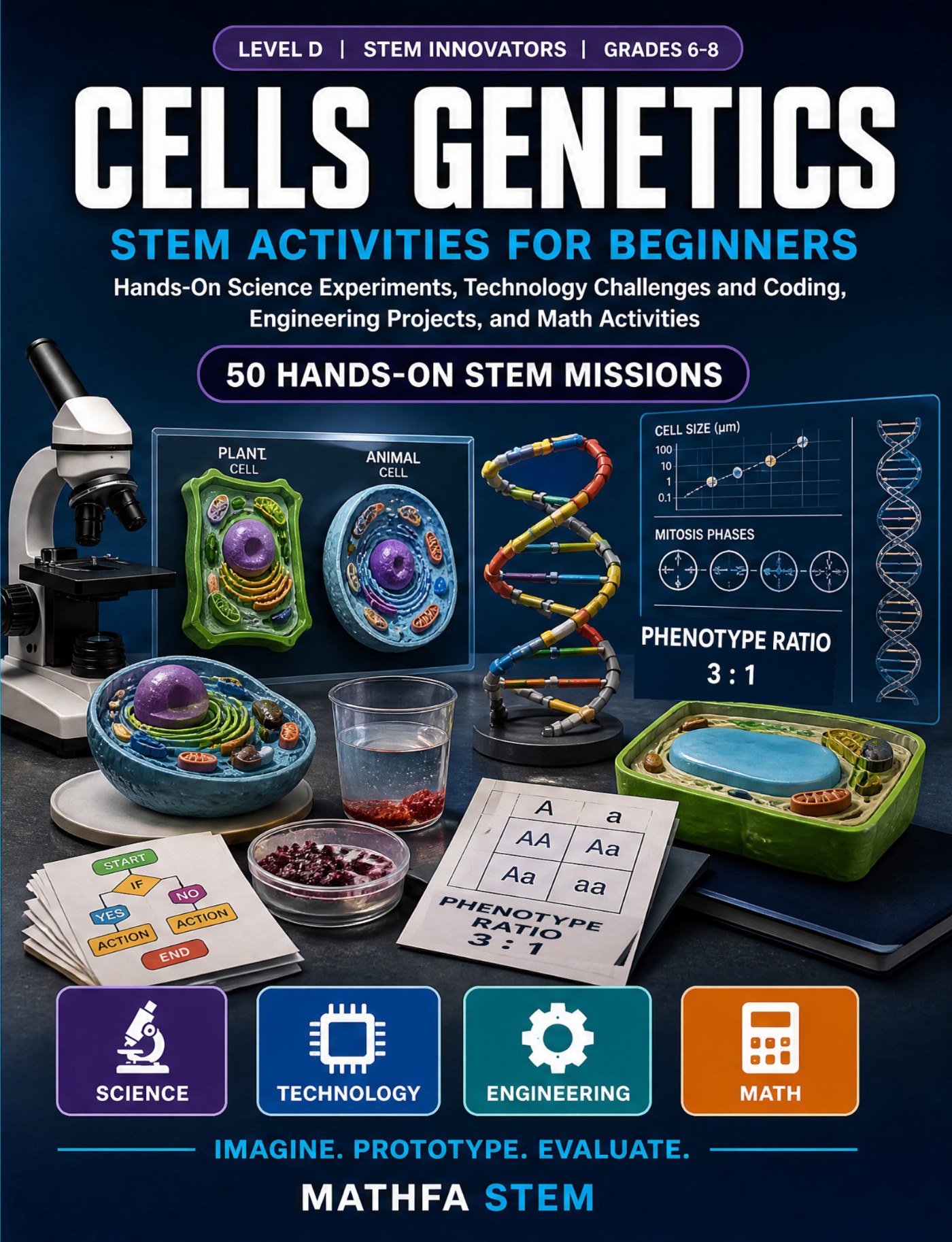
Build real cell biology and genetics skills in Grades 6–8 — investigate, measure, analyze and design across 50 two-page missions in a printable 124-page PDF. Download and begin today.
Middle school is when students start asking why and how do we know. Cells Genetics STEM Activities for Beginners answers with 50 hands-on missions for Grades 6–8 that build cell biology and genetics one idea at a time. As the book puts it: “Model, Compare, Explain Like a Cell Biologist.”
The book moves through seven sections: Cells & Cell Theory (8 missions, from The Discovery of Cells to Design a Cell Theory Investigation), Inside the Cell (7 missions, from Meet the Organelles to Design a Cell Comparison Study), Membranes & Transport (7 missions, from The Cell Membrane Gatekeeper to Plan a Transport Investigation), Cell Division & Growth (7 missions, from Why Cells Divide to Investigate Yeast Fermentation), DNA & Genes (7 missions, from The Shape of DNA to Design a Genetic Code Message), Heredity & Genetics (7 missions, from Dominant and Recessive Traits to Design a Heredity Prediction) and Variation, Biotech & Design (7 missions, from Mutations: Changes in the Code to Present Your Genetics Study). Every section opens with a mission plan, and the book ends with For Grown-Ups notes and a Certificate of Discovery for finishing all 50 missions.
Designed for students aged 11–13. It also works for homeschool families, middle-school teachers planning STEM units, tutors, and clubs — anyone who wants structured cell biology and genetics projects with clear goals.
Choose a regular STEM time — one mission per session works well. Read, predict, then build, measure or model. Record results on the Try & Draw page and discuss the evidence. When a section is complete, try its design challenge before moving on to the next.
For background on middle-school science and engineering practices, see the Next Generation Science Standards; for national education guidance, visit the U.S. Department of Education. On Mathfa, explore the Mathfa STEM hub, try Biomedical Engineering STEM Activities for Beginners, or browse the full Mathfa library.
Grades 6–8, ages 11–13. It is Level D (“Innovators”) of the four-level Mathfa STEM series.
Notebook, ruler, calculator, graph paper and pencils; check mission materials. Each mission lists exactly what it needs on its Try & Draw page.
50 two-page missions across 7 sections, plus For Grown-Ups notes and a Certificate of Discovery.
No. The sections build step by step, and every mission starts with a Look & STEM Idea page that explains the idea before the hands-on work.
A printable 124-page PDF, ready to download as soon as your order is complete. Print the missions you need or work from a tablet.
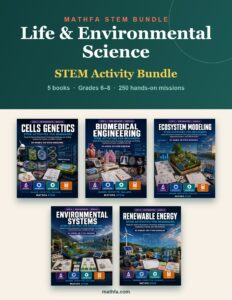
This book is part of a bundle
Life & Environmental Science STEM Bundle
Get all 5 books and save 31%.
Original price was: $94.95.$65.99Current price is: $65.99.
Reviews
There are no reviews yet.