Physics Projects STEM Activities for Beginners – 50 Hands-On Missions for Grades 6–8
$18.99
Add to cart
$18.99
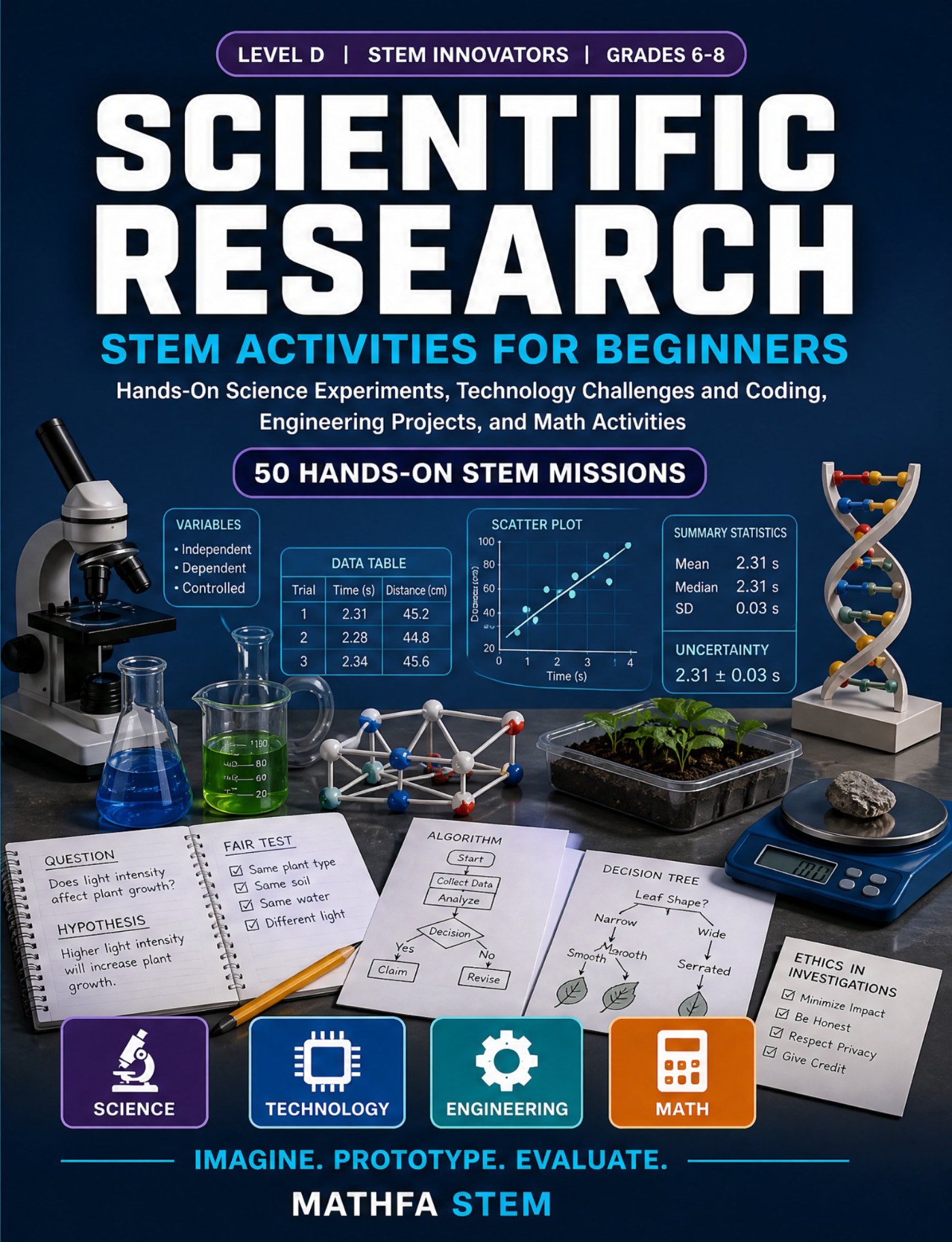
Question, Measure, Conclude Like a Researcher. 50 middle-school STEM missions in scientific research — Look & STEM Idea and Try & Draw pages, For Grown-Ups notes and a certificate. Start exploring today.
Scientific Research STEM Activities for Beginners is a complete, hands-on scientific research program for Grades 6–8. Fifty two-page missions across seven sections take students from core ideas to full investigations and design challenges, so they learn to work like a researcher.
The book moves through seven sections: Questions & Hypotheses (8 missions, from From Curiosity to a Testable Question to Designing a Question Board), Variables, Fair Tests & Controls (7 missions, from Controlled Variables to Building a Variable Sorter), Measurement & Units (7 missions, from The SI System to Building a Measurement Station), Accuracy, Error & Uncertainty (7 missions, from Accuracy vs Precision to Building Error Bars), Data, Tables & Graphs (7 missions, from Building a Data Table to Designing a Data Dashboard), Statistics, Patterns & Conclusions (7 missions, from Finding the Mean to Building a Statistics Toolkit) and Reproducibility & Research Ethics (7 missions, from Making Work Reproducible to Run a Full Investigation). Every section opens with a mission plan, and the book ends with For Grown-Ups notes and a Certificate of Discovery for finishing all 50 missions.
Two or three missions a week is a steady pace. Read the Look & STEM Idea page together, let the student lead the Try & Draw page, and talk through the results before moving on. Keep finished pages in a folder so students can see their progress through all seven sections.
It suits students aged 11–13, homeschool families building a STEM year, middle-school science and technology teachers, and after-school clubs that want structured projects without extra preparation.
For background on middle-school science and engineering practices, see the Next Generation Science Standards; for national education guidance, visit the U.S. Department of Education. On Mathfa, explore the Mathfa STEM hub, try Artificial Intelligence STEM Activities for Beginners, or browse the full Mathfa library.
Grades 6–8, ages 11–13. It is Level D (“Innovators”) of the four-level Mathfa STEM series.
Metric ruler, scale, timer, unbreakable volume measure, non-glass thermometer, notebook and graph paper. Use listed materials only. Each mission lists exactly what it needs on its Try & Draw page.
50 two-page missions across 7 sections, plus For Grown-Ups notes and a Certificate of Discovery.
No. The sections build step by step, and every mission starts with a Look & STEM Idea page that explains the idea before the hands-on work.
A printable 124-page PDF, ready to download as soon as your order is complete. Print the missions you need or work from a tablet.
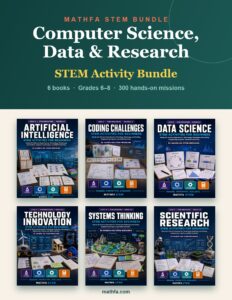
This book is part of a bundle
Computer Science, Data & Research STEM Bundle
Get all 6 books and save 31%.
Original price was: $113.94.$78.99Current price is: $78.99.
Reviews
There are no reviews yet.